-
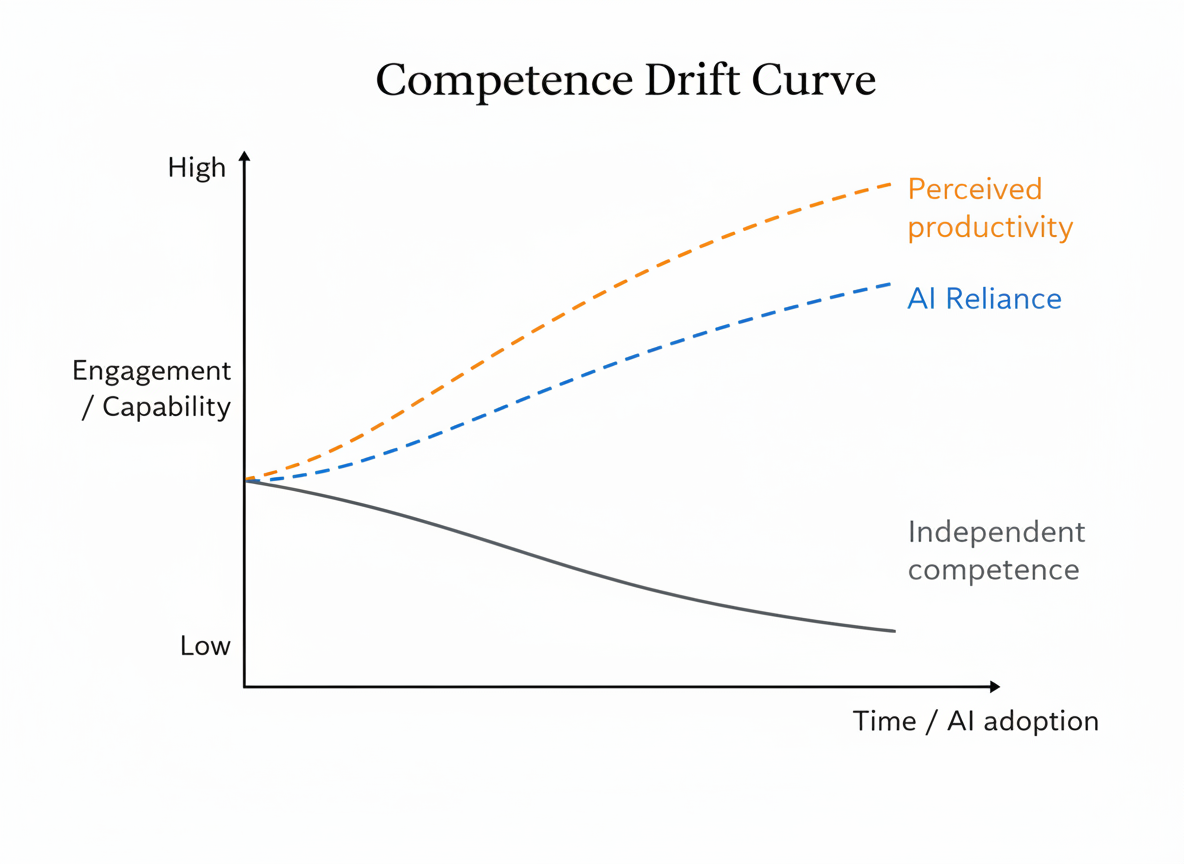
AI-Induced Deskilling & Competence Drift: The Quiet Cost of Cognitive Hand-Off
•
This is not a story about jobs disappearing. It is a story about systems quietly moving the thinking out of people and into the machine — then rewarding everyone for pretending nothing changed. The phenomenon has a name in the research literature: AI-induced deskilling — the measurable erosion of professional skills when humans over-rely…
-

The Promotion Trap: When Your Job Stops Being About Work
•
The promotion doesn’t break your job overnight. It quietly rewires it. One week you’re valued for what you ship. The next, shipping still matters—but only if it’s framed correctly, explained gently, and endorsed by the right people. Nothing in your title tells you this happened. You just notice that doing the work no longer…
-

When Corporate Systems Stop Moving Work and Start Managing Optics
•
Corporate systems aren’t born broken. Most start with a reasonable goal: coordination at scale. When ten people work together, you don’t need much structure. When ten thousand do, you need rules, tools, and rituals just to avoid chaos. The problem isn’t that systems exist. The problem is what they optimize for once the organization…
-

AI Is Creating Governance Debt
•
Every new technology creates technical debt.AI is creating something more dangerous: governance debt. Right now, organizations are deploying AI faster than they’re deciding who is accountable when it acts. That mismatch is the real risk—and it’s quietly compounding. Most AI systems don’t fail loudly. They fail diffusely. A model suggests. A workflow executes. A…
-
AI Is Ending the Traffic Era for Content
•
The internet was built on an implicit deal. You create something. Google sends people to it. Attention turns into leverage. That deal is breaking. Search is no longer a routing mechanism. It’s becoming a destination. AI summaries, answer engines, and chat interfaces increasingly absorb the user’s intent before a click ever happens. The question…
-

Optionality Is the Only Real Form of Security
•
Most people say they want security. What they’re really asking for is relief from uncertainty. Institutions are very good at selling that relief. A salary, a title, a predictable routine. It calms the nervous system. It feels like protection. But feelings aren’t positions, and security as a feeling has a habit of expiring right…
-

Corporate Jobs Feel Safer Because the Risk Is Invisible
•
Corporate jobs feel safe for the same reason slow leaks feel harmless. Nothing explodes. Nothing breaks loudly. Everything looks fine, until it isn’t. A salary hits your account every month. Health insurance works. HR sends polite emails about growth and well-being. Appraisals arrive on schedule. The brain concludes this is stability. But stability and…
-

How Convenience Quietly Undermines Good Design
•
Convenience is sold as progress. One tap. One swipe. One less decision. Everything faster, smoother, frictionless. It feels modern. It feels efficient. It feels like control. It isn’t. Convenience doesn’t just save time. It removes pauses. And pauses are where judgment lives. Most systems today are built around speed. Instant access. Instant reversals. Real-time…
-

The Hidden Reason AI Is Making People Nervous
•
AI isn’t coming for intelligence. It’s coming for vagueness. That’s the part nobody wants to say out loud. For decades, vague thinking has been a survival skill. You could talk around problems. Hide behind process. Sound busy without being precise. Ambiguity wasn’t a bug — it was protection. If nothing was clearly defined, nothing…
-

When Following the Rules Produces Bad Outcomes
•
Most failures don’t happen because someone broke the rules. They happen because everyone followed them. Perfectly. Rules exist to create order. They reduce ambiguity. They make responsibility legible. But once rules become the goal instead of the outcome, they start producing damage — quietly, legally, and with full approval. That’s what makes this…