
The narrative around AI in corporate environments is exhausted—hype about superhuman efficiency clashes with the grim reality of endless Slack pings, half-baked outputs, and a vague sense that everything’s accelerating toward nowhere. But here’s the unvarnished truth: AI isn’t just augmenting work; it’s fracturing it. By exposing and exacerbating longstanding flaws in how knowledge workers operate—vague directives, siloed decisions, and performative busyness—AI is turning the office into a pressure cooker. The result? Workers feel busier than ever, yet tangible progress stalls. This isn’t a tech glitch; it’s a system failure amplified by algorithms that prioritize speed over substance.
Drawing from the latest 2026 insights, including surging adoption rates and emerging economic dashboards, this piece dissects the current landscape: what’s really happening on the ground, where the risks lurk for knowledge workers, and a pragmatic roadmap for survival over the next 5–10 years. Forget the apocalyptic job-loss tropes; the real threat is irrelevance in a world where AI reshapes value creation. But amid the chaos, opportunities emerge for those who adapt—not by chasing tools, but by rebuilding how humans and machines collaborate. For deeper dives into related systemic issues, see AI Is Creating Governance Debt and When Corporate Systems Stop Moving Work and Start Managing Optics, which unpack the foundational cracks AI exploits.
The Ground Truth: AI Adoption Is Everywhere, But Value Is Elusive
AI has infiltrated workplaces faster than anticipated. As of early 2026, 72% of organizations report using AI in at least one business function, up from 56% in 2021. Among U.S. employees, 45% now use AI at least a few times a year, with 23% incorporating it weekly and 10% daily—a steady climb from prior quarters. In knowledge-heavy sectors like finance and healthcare, adoption hits even higher: 78% of marketing teams leverage AI for segmentation, while 66% of physicians use it for diagnostics. Yet, the productivity payoff remains spotty. A McKinsey survey reveals 85% of workers save 1–7 hours weekly with AI, but nearly 40% of that time evaporates in “rework”—fixing errors, rewriting content, or verifying outputs from generic tools. This “productivity paradox” echoes historical tech shifts: despite billions poured into AI (global spending projected at $300 billion in 2026), broad economic metrics show no surge. Instead, employees report wasting 4.5 hours weekly on “workslop”—low-quality AI-generated content that demands human cleanup. In manufacturing, early adopters even face temporary performance dips before long-term gains materialize. On the ground, this manifests as fragmented workflows. A Workday study finds 95% of organizations see no measurable ROI from generative AI, despite $30–40 billion in 2025 investments. Knowledge workers, once shielded by complexity, now grapple with AI that drafts reports in seconds but often misses context, sparking endless revision cycles. Add in uneven training—only 33% of users receive formal guidance—and the result is a workforce that’s faster at producing, but slower at deciding. This mirrors the “governance debt” buildup explored in AI Is Creating Governance Debt, where unchecked AI integration creates long-term accountability voids.
The Hidden Perils: Deskilling, Displacement, and Debt-Fueled Overreach
Knowledge workers shouldn’t panic about wholesale job loss—yet. Anthropic’s 2026 study shows AI augments tasks more often than it automates them, with 49% of jobs now using AI for at least a quarter of activities, up from 36% in early 2025. The World Economic Forum projects a net gain: 170 million new roles by 2030 against 92 million displaced. But the risks are subtler and more insidious.
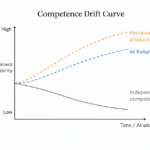
First, deskilling looms large. AI excels at high-education tasks like analysis and drafting, potentially eroding human expertise. Microsoft’s New Future of Work Report warns that overreliance could weaken judgment, planning, and domain knowledge, especially among juniors. Entry-level roles are already vanishing: Stanford/ADP data shows a 16% drop in AI-exposed positions for early-career workers. Young employees (22–25) in vulnerable occupations face 13% employment declines since ChatGPT’s 2022 launch. This “canary in the coal mine” signals broader shifts: AI handles routine cognitive work, pushing humans toward oversight—but without skills to bridge the gap. It amplifies the “invisible risks” in corporate structures, as detailed in Corporate Jobs Feel Safer Because the Risk Is Invisible.
Second, economic vulnerabilities mount. Corporations’ AI spree has triggered a debt boom: hyperscalers issued $121 billion in 2025 bonds for data centers and infrastructure, quadrupling prior averages. Projections hit $1.5 trillion over five years, risking a “CapEx bust” if returns falter, akin to the dot-com crash. For knowledge workers, this means instability: overhyped investments could lead to cutbacks, with AI-exposed roles first on the chopping block.
Third, social bonds fray. Remote work amplified by AI agents risks isolating teams, reducing serendipitous collaboration that sparks innovation. Gartner’s 2026 trends highlight “culture dissonance” from overfocus on AI, breeding low-quality output and burnout. Indeed, 83% of workers report wellness concerns amid AI pressures. These risks compound for knowledge workers: what was once “safe” intellectual labor now faces commoditization, with 93% of jobs AI-exposed. The fear isn’t obsolescence tomorrow, but gradual erosion—roles hollowed out, skills atrophied, and leverage lost, much like the drift toward optics over output in When Corporate Systems Stop Moving Work and Start Managing Optics.
The Upside: Opportunities in a Hybrid Horizon
Amid the threats, AI unlocks unprecedented leverage for savvy knowledge workers. PwC’s 2025 AI Jobs Barometer shows AI-savvy roles command 56% wage premiums, with job growth in exposed sectors outpacing others. By 2030, AI could boost global GDP by 15%, adding $15.7 trillion—mostly through productivity gains in knowledge work. Key opportunities:
- Augmented Expertise: AI handles grunt work, freeing humans for high-value synthesis. In R&D, AI accelerates discovery: drug development timelines could halve, per IBM projections. Knowledge workers who “orchestrate” AI—framing problems, validating outputs—become indispensable.
- New Roles Emerge: Demand surges for AI ethicists, prompt engineers, and human-AI coordinators. SHRM’s 2026 report predicts 84% of CHROs will upskill in AI-specific competencies. “Power skills” like ethical judgment and collaboration rise, per Gartner.
- Resilience Through Polywork: With polywork trending (up due to economic anxiety), AI enables side gigs: freelancers use tools like ElevenLabs for voiceovers or Gemini for analytics, commanding premiums. This builds on the idea that true security lies in optionality, as explored in Optionality Is the Only Real Form of Security.
Over 5–10 years, the landscape evolves to “superagency”: humans empowered by agents handle complex tasks, per McKinsey. But success hinges on equity: those with access to training thrive, while others lag.
Emerging Tools: From Assistants to Agents
To capitalize, integrate cutting-edge tools. Microsoft’s Copilot embeds in Office suite, saving hours on drafting while flagging biases. Claude and Gemini excel at reasoning: use for scenario planning, with Claude’s success rates weighting task automation. Agentic AI like Zapier Agents or Botpress automates workflows—e.g., data entry to reporting—piloted by 38% of orgs. For governance, tools like Notion AI organize knowledge, mitigating debt by tracking decisions.
Train on these: 74% use AI without guidance, per Lifewire—close that gap for edge. For content creators navigating AI’s disruptions, see AI Is Ending the Traffic Era for Content, which highlights shifts in value beyond traditional metrics.
No-Bullshit Survival Guide: Prepare Yourself and Your Team
Should knowledge workers worry? Yes, but channel it into action. Over 5–10 years, AI won’t eradicate jobs but will stratify them: adaptors win, resisters fade. Here’s how to fortify:
- Audit and Upskill Ruthlessly: Map your role’s AI exposure—tools like the IMF’s metrics show 3.6% lower employment in high-AI demand regions. Prioritize “human premiums”: strategic framing, ethics. Mandate team training—92% of CHROs plan AI upskilling. Start with free resources: Coursera’s AI ethics courses.
- Redesign Workflows for Hybrid Strength: Treat AI as collaborator, not crutch. Implement “validation loops” to combat workslop. For teams: foster “change fitness”—regular AI pilots to build adaptability, per Baker Library. Measure ROI: track time saved vs. rework.
- Cultivate Optionality: Build poly-skills—AI fluency plus domain expertise. Encourage side projects: use agents for freelancing. For leaders: diversify talent pipelines, targeting AI-savvy hires (7x demand growth).
- Address Risks Head-On: Mitigate deskilling with “human-in-loop” protocols. Monitor debt exposure—AI infra borrowing could spike volatility. Promote wellness: counter isolation with intentional collaboration.
- Lead Ethically: As agents proliferate (11% in production, 38% piloting), prioritize transparency—57% want bias-reduced hiring AI. Build “net-positive” frameworks: AI that enhances, not erodes, human value.
The Stark Reality Ahead
AI’s siege on knowledge work isn’t about replacement—it’s about revelation. By 2030, we’ll see diamond-shaped workforces: mid-level orchestrators thriving, entry-levels squeezed. Winners will be decisive humans who wield AI to resolve, not proliferate, ambiguity. Losers? Those clinging to outdated rituals. The horizon is hybrid: AI amplifies inequality, but also potential. Prepare now—reskill, redesign, and reclaim agency—or risk becoming the governance debt you once ignored. The future belongs to the adaptive.